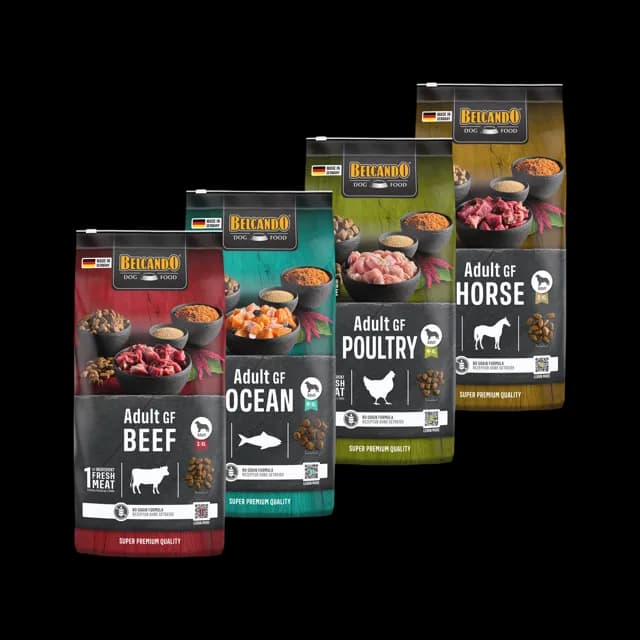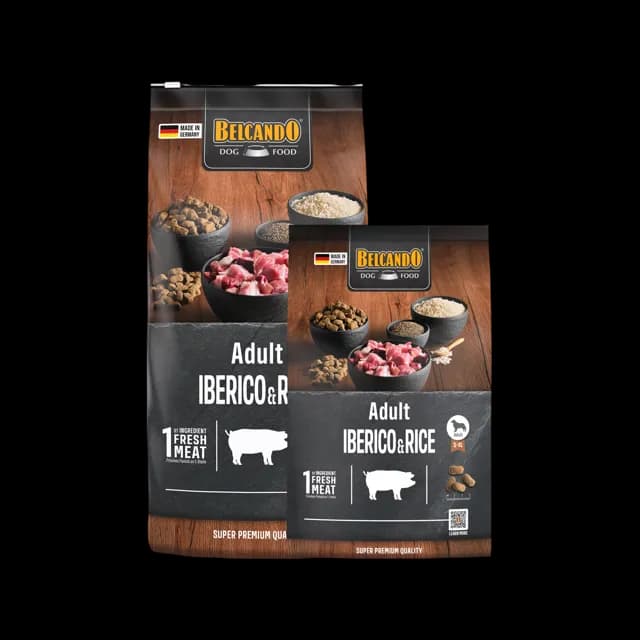



Belcando
Belcando Junior Grain-Free review
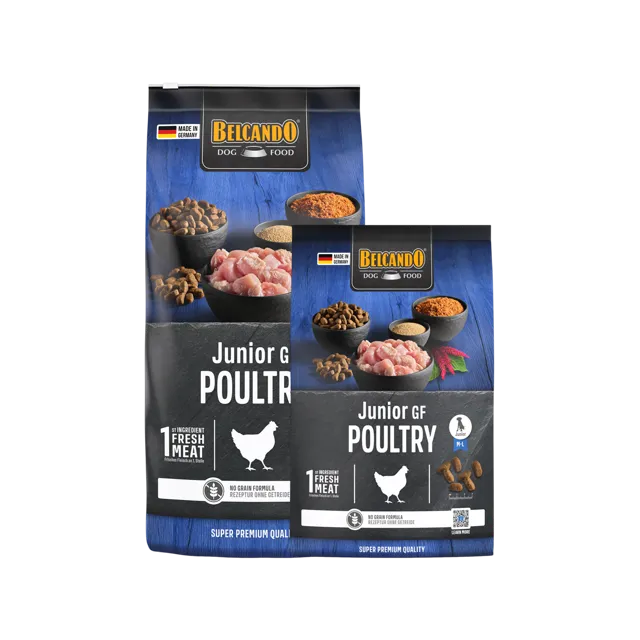
Belcando Junior Grain-Free is a growth kibble that builds itself on birds without ever saying which ones. Fresh poultry meat leads at 40%, with low-ash dried poultry protein at 14% behind it. Amaranth and potato starch stand in for cereal, and krill and sea fish meal bring a marine layer high up the list. Calcium is declared and converts to 1.33% of dry matter, comfortably inside what growing bone works to. The reading comes out in our Good band, and the notes below explain why a list this generous lands there.
Our view
Likely to suit
If you are raising a pup without grain and you want the mineral side of the label to hold up, this bag makes a fair case for itself.
- Owners of medium and giant breed pups who check calcium first, since it is declared at 1.33% of dry matter and sits inside the range growth works to
- Owners feeding a cereal-free bowl, with amaranth at 16% joined by potato starch and pea flour
- Pups who take happily to a marine note, with ground krill at 2.5% and sea fish meal at 2.5% alongside the poultry
- Owners who like the micronutrient panel spelled out, taurine at 500 mg/kg and zinc at 125 mg/kg among the doses in print
Worth watching
A few of this label's habits are worth understanding before it becomes your pup's everyday bag.
- Poultry is the only word used for the birds in this recipe, so a pup on a species-specific plan needs that pinned down with the maker
- Krill, sea fish meal and salmon oil all put fish through the recipe, which matters for a pup that has reacted to it before
Written by our editorial team. Independent guidance, not veterinary advice.
How this scores
How we scoreThe Details
Dog fit
If you are raising a pup without grain and you want the mineral side of the label to hold up, this bag makes a fair case for itself. A few of this label's habits are worth understanding before it becomes your pup's everyday bag.
Dry
Puppy
Medium, Giant
Poultry
The score, in context
Our reading lands this one in our Good band, which will look modest next to an ingredients list of this kind, so here is the plain version. Protein and processing and nutritional balance both come out Average, with transparency reading Excellent and value Good. Fresh meat at 40% is largely water before it ever becomes kibble, which is why the finished protein figure is a moderate 26.0%, or 28.9% once the moisture is taken out. Carbohydrate converts to 43.1% of dry matter where a typical growth kibble runs at 39.0%, and energy is an estimated 354 kcal per 100g against a 376 typical. Add a label that names no bird anywhere on it and the picture the analysis gives is a good deal plainer than the one on the front of the bag. The typical puppy dry food, by comparison, sits in that same Good band.
What's in it
Ingredients, as declared: Fresh poultry meat (40%); Amaranth (16%); Low-ash poultry protein, dried (14%); Potato starch; Pea flour; Ground zooplankton (Krill, 2.5%); Sea fish meal (2.5%); Hydrolyzed gelatin (2.5%); Dried baker's yeast (2.5%); Dried egg; Dried carob bean gum; Dicalcium phosphate; Poultry fat; De-sugared dried beet pulp; Chia seeds; Hydrolyzed poultry liver; Salmon oil; Sodium chloride; Potassium chloride
Named ingredients
Nutritional additives
- Vitamin A 15,000 I.U.; Vitamin D3 1,500 I.U.; Vitamin E 150 mg; Taurine 500 mg; Copper (as copper-(II)-sulphate, pentahydrate) 12.5 mg; Iron (as iron-II-sulphate, monohydrate) 200 mg; Manganese (as manganese-II-oxide) 40 mg; Zinc (as zinc oxide) 125 mg; Iodine (as calcium iodate, anhydrous) 2 mg; Selenium (as sodium selenite) 0.05 mg - Tocopherol extracts of vegetable oils (= natural vitamin E) 48 mg - _No lecithin is declared here, unlike Belcando Junior and Junior Maxi._
Ingredient notes
Fresh poultry meat at 40% is the headline, and it helps to know what happens to it. Most of the weight in fresh meat is water, and a large share of that 40% cooks away before the kibble is finished. The dried low-ash poultry protein at 14% is the entry doing the heavier work on the protein line, because its water has already gone. The declared 26.0% protein, 28.9% on a dry matter basis, is the honest end result of the two together.
Neither of those entries names a bird. Poultry is a category, not a species: turkey, goose, duck and chicken all count. A maker can move between birds from batch to batch. Most pups will never notice. An owner trying to work out what upset a sensitive tummy will notice a great deal, and this is the single thing the label could most usefully change.
Amaranth at 16% is the interesting choice here, a seed rather than a cereal, and it carries the biscuit with potato starch and pea flour. Between them they put carbohydrate at 38.8% as fed, 43.1% of dry matter, above the 39.0% typical. De-sugared beet pulp adds fibre at a modest 2.8%, which most puppy digestion handles without fuss.
The marine end of the list is more thoughtful than most growth bags manage. Ground zooplankton, listed as krill at 2.5%, sits with sea fish meal at 2.5% and salmon oil further down, and between them they are where the long chain omega 3 in this recipe comes from.
Minerals are the part of this label that earns its keep. Dicalcium phosphate is added deliberately, calcium converts to 1.33% of dry matter, and crude ash reads 7.4%, or 8.2% of dry matter. For a bag listed for medium and giant pups, a declared, in-range calcium figure is exactly what an owner should be looking for, and plenty of growth foods do not print one at all.
The additive panel prints a dose against every name: vitamin D3 at 1,500 IU, vitamin E at 150 mg, taurine at 500 mg, iron at 200 mg and zinc at 125 mg. Vitamin A is dosed above all of them, and tocopherol extracts at 48 mg keep the fats stable. Lecithin, which this brand prints on some of its other junior bags, is not declared on this one.
The energy figure is our estimate rather than a declaration, at 354 kcal per 100g, and it sits under the 376 a growth kibble usually carries. That is not a fault in itself, though it does mean a hungry pup works through a bag a little faster than the number on the front might suggest.
Price and value
£4.97 a kilo, sold in 4kg and 12.5kg bags.
There is no fixed daily amount to quote for a growing dog, because the right portion climbs through the early months and then eases back as the frame finishes. Feed to the chart on the bag for the adult weight you expect, and let your pup's shape settle the final number.
Nutritional analysis
Declared analysis
Estimated using Modified Atwater factors*
26%
15%
2.8%
7.4%
10%
Dry weight
28.9%
16.7%
3.1%
8.2%
43.1%
As-fed composition
Estimated breakdown of the finished product by ingredient category, from the declared ingredient list and ingoing weights. These are estimates, not measurements.
74.1%
25.9%
Pricing & size
- Pack size
- 4 kg, 12.5 kg
- Retailer pricing
- Coming soon
Live retailer pricing is not yet available for this food. Prices, cost per day and where to buy will appear here once retailer data is live.
Ingredients and nutrition are taken from manufacturer data. Retailer pricing is not yet live for this food.
Related dog food guides
Ranked shortlists that include foods like this one.