


Skip to content
Off the Leash
Bakers Puppy – —

Bakers

Bakers Puppy review

26.9/100Poor
DryPuppy

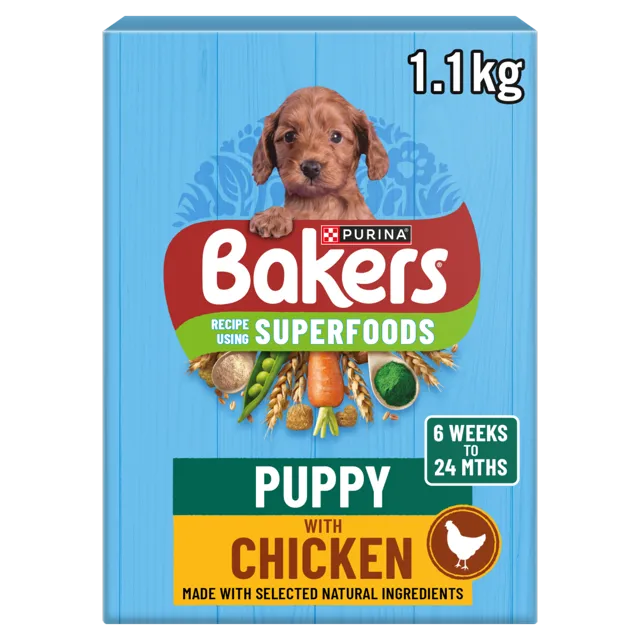
Bakers Puppy is a wholegrain cereal based kibble from one of the most widely stocked names on the shelf. Cereals lead the recipe at 49%, meat and animal derivatives follow with 4% of the food identified as chicken, and dried pea, dried carrot and spirulina add a little colour at the end. Our Poor band is where this one finishes, with protein at 27.2% of dry matter and carbohydrate estimated at 48.9%.

Where to buy: coming soon
Live retailer pricing is coming soon. Once we have prices from UK retailers, the best price, cost per day and where to buy will appear here.

Our view

Likely to suit

Plenty of dogs in this country have been raised on this bag, and yours may well be one of them.

  • Puppies already settled on it and doing nicely, since the middle of growth is no time to change a food without a reason
  • Owners who want a grain led kibble, with wholegrains declared at 49% of the recipe
  • Households that need to restock without a special trip, since this is one of the easiest puppy foods in the country to find
  • Pups whose owners like a little greenery in the bowl, with dried pea and dried carrot at 0.3% each and spirulina at 0.2%

Worth watching

The way this label is written is the part to understand before you buy it.

  • Meat and animal derivatives carries the animal content, with only 4% of the recipe named as chicken, so the rest cannot be traced to a species
  • Cereals is written as a category, not as a named grain, which means wheat can be neither ruled in nor ruled out from the label
  • Oils and fats, derivatives of vegetable origin and vegetable protein extracts are all left unnamed too, which rules the label out for elimination work
  • Carbohydrate converts to an estimated 48.9% of dry matter against 39.0% typical, so this is a notably starchy growth food
  • The panel prints no calcium figure at all, and this bag is sold for pups of any eventual size, so an owner rearing a large breed has nothing to work from

Written by our editorial team. Independent guidance, not veterinary advice.

How this scores

How we score
26.9/100Poor
Protein and processingPoor
Nutritional balanceAverage
TransparencyOutstanding
ValuePoor

The Details

Dog fit

Plenty of dogs in this country have been raised on this bag, and yours may well be one of them. The way this label is written is the part to understand before you buy it.

Food type

Dry

Life stage

Puppy

Breed size

Toy, Small, Medium, Large, Giant

Main protein

Chicken

The score, in context

This one comes out in our Poor band, some way under the Good band a typical puppy kibble reaches, with protein and processing reading Poor and nutritional balance no better than Average.

The reason has less to do with any one ingredient than with how little the label commits to. The animal content, the grain, the fats and the vegetable protein are all described by category, never by name. A recipe written that way can be altered from batch to batch without a word of the list changing. That leaves an owner unable to say what their pup ate last month, let alone whether it agreed with them.

What's in it

Ingredients, as declared: Cereals (wholegrains 49%), Meat and animal derivatives (of which 4% chicken), Derivatives of vegetable origin (of which 2.9% dried beet pulp), Oils and fats, Glycerol, Vegetable protein extracts, Minerals, Vegetables* (of which 0.3% dried pea and 0.3% dried carrot), Spirulina* (0.2%), *natural ingredients, equivalent to 4% rehydrated vegetables

Named ingredients

Cereals (wholegrains 49%), Meat and animal derivatives (of which 4% chicken), Derivatives of vegetable origin (of which 2.9% dried beet pulp), Oils and fats, Glycerol, Vegetable protein extracts, Minerals, Vegetables* (of which 0.3% dried pea and 0.3% dried carrot), Spirulina* (0.2%), *natural ingredients, equivalent to 4% rehydrated vegetables

Nutritional additives

Nutritional additives IU/kg: Vitamin A : 19000 Vitamin D3 : 1100 Vitamin E : 90 mg/kg: Iron (II) sulphate monohydrate : (Fe: 78) Calcium iodate anhydrous : (I: 1.9) Copper (II) sulphate pentahydrate : (Cu: 8.7) Manganous sulphate monohydrate : (Mn: 5.9) Zinc sulphate monohydrate : (Zn: 110) Sodium selenite : (Se: 0.19)

Ingredient notes

Cereals at 49% is the largest entry, and the word covers everything from an excellent grain to a very poor one. Some makers use it to keep a formula to themselves, others so they can move between grain sources as supply changes. Either way, the owner cannot tell which grain is in the bowl.

Meat and animal derivatives comes next, with 4% of the recipe declared as chicken. In law the term takes in the fleshy parts of slaughtered land animals along with the products of processing a carcass. That spans a wide range of quality, and this label does not say where in that range it sits. Beyond the named chicken, the animal content cannot be pinned to a species.

The same pattern turns up in three more places. Derivatives of vegetable origin, oils and fats, and vegetable protein extracts all describe a class of material rather than an ingredient. Dried beet pulp at 2.9% is named inside the first of them and is a useful, well tolerated fibre, but the rest of that space is left open.

Glycerol sits fairly high on the list. It is a sweet, syrupy carbohydrate whose job is to keep a kibble soft and appealing. Glycerol is one reason the carbohydrate estimate reaches 48.9% of dry matter while protein stops at 27.2%.

The named good things come right at the end and in small amounts: dried pea and dried carrot at 0.3% each and spirulina at 0.2%, which the label notes as equivalent to 4% rehydrated vegetables. Peas and carrots are genuinely worth having in a diet, but at these levels treat them as a flourish rather than a plank of the nutrition.

The declared analysis reads protein 25.0%, fat 12.0%, fibre 3.0%, ash 7.0% and moisture 8.0%. The maker declares energy at 357 kcal per 100g, where a puppy dry food typically carries 376. There is no calcium figure anywhere, which in a food sold for growth is the omission that matters most, and no large breed claim can rest on a number the label never prints.

The vitamin and trace element panel is dosed in print, with selenium supplied as sodium selenite. That is the standard mineral form across the industry, though the yeast bound version is better taken up by the dog.

Price and value

Sold in 1.1kg, 2.85kg and 12.5kg bags.

What a pup needs at ten weeks is nothing like what the same pup needs at six months. Follow the stage by stage guide on the pack, and let your hands over their ribs settle any argument about the amount.

Nutritional analysis

Declared analysis

Energy
357 kcal/100g
Protein

25%

Fat

12%

Fibre

3%

Ash

7%

Moisture

8%

Dry weight

Protein

27.2%

Fat

13%

Fibre

3.3%

Ash

7.6%

Carbs

48.9%

As-fed composition

Estimated breakdown of the finished product by ingredient category, from the declared ingredient list and ingoing weights. These are estimates, not measurements.

Meat

24.9%

Carbs

59%

Veg

5.3%

Oils

5.3%

Other

5.5%

Pricing & size
Pack size
1.1kg, 2.85kg, 12.5kg
Retailer pricing
Coming soon

Live retailer pricing is not yet available for this food. Prices, cost per day and where to buy will appear here once retailer data is live.

Ingredients and nutrition are taken from manufacturer data. Retailer pricing is not yet live for this food.

Related dog food guides

Ranked shortlists that include foods like this one.

All reviews

Featured feeding accessories

All feeding accessories

Brackenwood

Slow Feeder Maze Bowl

Slows fast eaters and eases gulping at mealtimes.

From £12.99· 4 retailers
View

Tarn & Co

Raised Double Diner

Height-set stand for easier, tidier eating.

From £28.99· 3 retailers
View

Reviewed by Off the Leash Editorial

Last updated 28 August 2026