

Aniforte
AniForte PureNature Junior Menu review
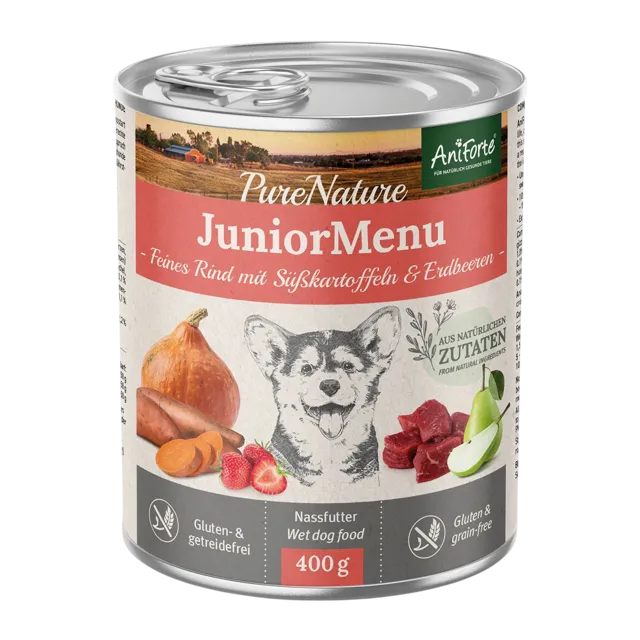
AniForte PureNature Junior Menu reads like a shopping list rather than a formula. Chicken makes up 60.0% of the tin, named part by part from heart and meat through to liver, stomach and neck. Chicken stock accounts for another 26.0%, and a short run of vegetables, fruit and seaweed finishes it. Protein converts to 40.4% of dry matter, calcium is declared at 0.96%, and the recipe sits in our Outstanding band.
Our view
Likely to suit
If you would rather read a tin's label than decode it, this one makes that easy.
- Puppies who do best on chicken, the only meat in the tin and 60.0% of what is inside it
- Owners who want the offal named, with heart, liver, stomach and neck each listed instead of pooled under one word
- Pups expected to finish large or giant, with calcium declared and converting to 0.96% of dry matter, within what growth asks for
- Households with a fussy junior or a pup on kibble who needs tempting, since a tin at 75.0% moisture brings water and appeal to the same bowl
Worth watching
Before this tin becomes the whole of your pup's diet, there are a few label points to know.
- Egg shell powder puts egg on the label and the omega-3 extract names no source
- Chicken carries the whole recipe, so a pup who reacts to chicken is not the one this tin is for
Written by our editorial team. Independent guidance, not veterinary advice.
How this scores
How we scoreThe Details
Dog fit
If you would rather read a tin's label than decode it, this one makes that easy. Before this tin becomes the whole of your pup's diet, there are a few label points to know.
Wet
Puppy
Toy, Small, Medium, Large, Giant
Chicken
The score, in context
Our Outstanding band takes this one in, one step above where the typical wet puppy food settles, so the company it keeps up there is strong and never easy. It finishes well ahead of that middle mark all the same.
Protein and processing, nutritional balance and transparency all read Outstanding, which is unusual. That comes from one source: a short list where almost every entry carries its own percentage, and a declared analysis that agrees with what the list promises.
What's in it
Ingredients, as declared: 60.0% Chicken (Chicken Heart, Chicken Meat, Chicken Liver, Chicken Stomach, Chicken Neck), 26.0% Chicken Stock, 4.0% Carrots, 3.0% Courgettes, 2.0% Fennel, 2.0% Potatoes, 1.0% Raspberries, 1.0% Apples, 0.1% Egg Shell Powder, 0.1% Herbs (Dandelion, Yarrow, Fennel, Camomile), 0.1% Yeast, 0.1% Linseed, 0.1% Rapeseed Oil, 0.1% Desiccated Coconut, 0.1% Silica, 0.1% Spirulina, 0.1% Omega-3 Extract, 0.1% Seaweed Calcium.
Named ingredients
Ingredient notes
Chicken at 60.0% is broken into heart, meat, liver, stomach and neck. That is an offal-rich build in the old-fashioned sense, and it is a good thing in a growth food. Liver in particular is one of the most nutrient dense foods a dog can eat, rich in vitamin B12 and vitamin A, with copper and iron alongside. Heart and neck bring muscle protein and connective tissue. Declared protein of 10.1% works out at 40.4% of dry matter, a strong figure for a tin.
Chicken stock at 26.0% is the cooking liquid from the same bird, so it adds flavour and moisture without introducing a second species. Adding the two together, 86% of the tin comes from the bird, and no other animal protein appears at all. The one qualification is the omega-3 extract in the tail, which names nothing, so a fish free plan needs it confirmed.
Carrots at 4.0%, courgettes at 3.0%, fennel at 2.0% and potatoes at 2.0% make up a small, named plant side, with raspberries and apples at 1.0% each. Carbohydrate is estimated at 6.0% as fed, which converts to 24.0% of dry matter against a 13.6% typical for wet puppy food. That estimate is made by difference, so everything the label does not declare separately lands inside it. In a food that is three quarters water, a small as-fed figure scales up quickly once the water is taken out.
The 0.1% tail is where the interesting extras sit. Egg shell powder and seaweed calcium cover the mineral side. Linseed and rapeseed oil bring the fats, and then there are spirulina, yeast, desiccated coconut, silica, an omega-3 extract, and a named herb blend of dandelion, yarrow, fennel and camomile. Individually these are garnish, but the two calcium sources are doing real work because no mineral panel is printed anywhere else.
Ash is declared at 2.2%, or 8.8% of dry matter, and calcium comes out at 0.96% of dry matter. That is a sensible level for growth, including for a pup who will finish large, where an oversupply is the more common problem. Fat at 6.1% converts to 24.4% of dry matter, so the tin is rich enough to matter in a small serving.
Energy works out at 108 kcal per 100g on our estimate, close to the 106 typical of a wet puppy food, since the label prints no calorie figure of its own. Fibre is minimal at 0.6%, which most puppy digestion handles without a second thought.
Price and value
Sold in 400g cans.
No growing dog has a fixed daily amount, so take any figure as a starting point. From our standard energy estimate, a 10kg pup between 4 and 12 months of age works through roughly 655 to 800 grams a day. A wet diet fills the bowl faster than kibble does, so judge by your pup's shape as much as by the tin.
Nutritional analysis
Declared analysis
Estimated using Modified Atwater factors*
10.1%
6.1%
0.6%
2.2%
75%
Dry weight
40.4%
24.4%
2.4%
8.8%
24%
As-fed composition
Estimated breakdown of the finished product by ingredient category, from the declared ingredient list and ingoing weights. These are estimates, not measurements.
86.1%
2%
8.2%
0.1%
3.6%
Pricing & size
- Pack size
- 400g cans
- Retailer pricing
- Coming soon
Live retailer pricing is not yet available for this food. Prices, cost per day and where to buy will appear here once retailer data is live.
Ingredients and nutrition are taken from manufacturer data. Retailer pricing is not yet live for this food.
Related dog food guides
Ranked shortlists that include foods like this one.